
Generations of kids grew up dreaming of becoming a cowboy in the romantic Old West. On TV or on the silver screen, the cowboy life was always presented as a life with strong morals. Men were strong and women virtuous. There were good guys in white hats and villains in black hats—and frontier justice always seemed to triumph over evil.
Many Americans grew up watching the TV series, Rawhide. Set in the late 1800s, in the American West, a young Clint Eastwood, starred as Rowdy Yeates,driving an ornery herd of Texas Longhorn cattle along dusty trails to the marketplace. Gil Favor, the trail boss, and Charlie, the camp cook, dispensed wisdom as our heroes encountered countless challenges along the dusty trail.
A lot has changed in the decades since that TV series first aired. But some things just have to be done on the ranch- Cattle still need to be branded and dehorned. Cattle still calve, so they’ll need ear-tagged, herded, fed and watered. When calving, animals need to be watched closely, so they’re generally kept close to home in a well- protected area. Then as spring arrives and calves mature, they are often moved to summer ranges, to forage grass and underbrush. Driving along many country roads, it’s not unusual to suddenly come into a herd as the road rounds a bend. You need to travel cautiously- no one wants to run into a cow. Though they don’t really bounce, they’re extremely hard to budge and auto body work is expensive!.
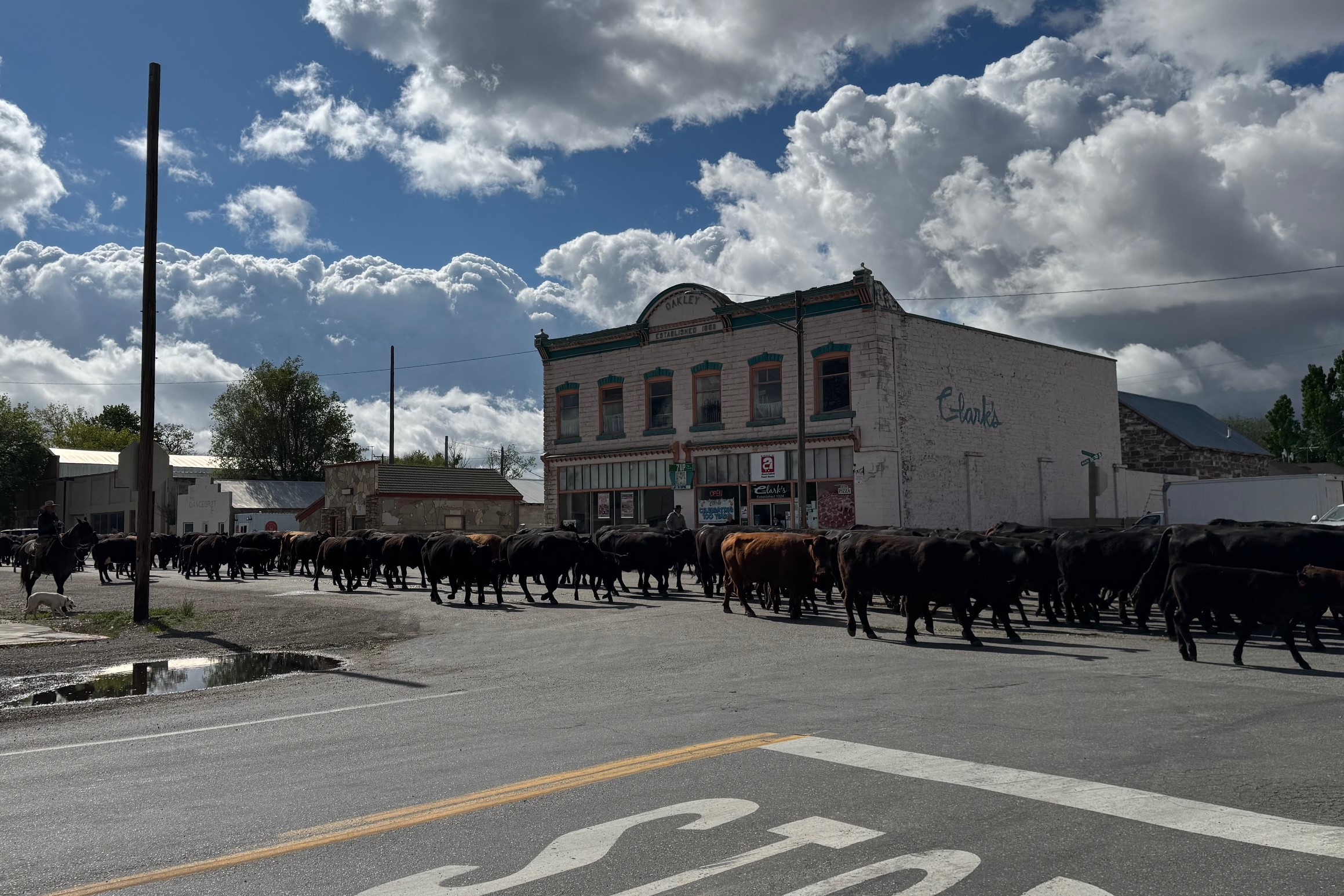
It’s not uncommon to encounter a herd of cattle, moving slowly along roads in many rural areas. What’s not so common is to run into a herd in the middle of a town. You hardly ever hear about that these days, unless you’re in Oakley, Idaho in mid to late April or October. The cows on Eugene Matthews’ ranch winter best east of town, in the Basin area. But since their summer range is west of town towards Bostetter, when spring comes, the best solution is to move them in a (sometimes semi-) straight line down Main Street. It’s not really hard to tell if the semi-annual parade has taken place or not. Cattle have a distinct way of marking where they’ve traveled, and where there’s been a lot of cattle, there’s lots of evidence left behind. You don’t have to guess where they’ve been. And since the Matthews operation often moves up to 500 cattle from point A to Point B (and back again) there’s generally lots of evidence of who went where. Just be careful where you step or drive- if you know what I mean.
Moving the cattle is a real family experience, with the whole family pitching in to enjoy the bi-yearly herding spectacle. Youngsters and old hands all join in-with all hands aboard, men, women and youngsters alike. Hats are waved, coiled lassos spun and twirled, as herders whistle, crack ropes and yell to “Get on, now,” or sic their dogs on stragglers lagging behind the herd.
It’s quite the spectacle, though the day’s never complete without a memorable family meal at the end of a very long day. After horses are unsaddled and rubbed down, the whole family gets together to swap stories from their day, to brag of someone’s abilities, or otherwise just enjoy each others’ company. It’s the perfect ending in a cowboy’s life. And I guess if push comes to shove, if an animal won’t cooperate, it can still be enjoyed one forkful at a time.
Leave a Reply
You must be logged in to post a comment.