
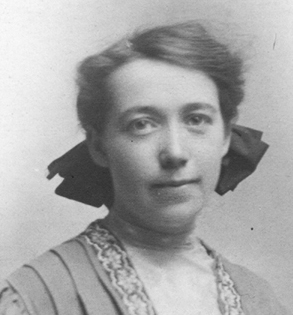
Minerva Bernetta Kohlhepp Teichert was a prolific American painter of Western art and subjects from the teachings of the Church of Jesus Christ of Latter-day Saints. Minerva’s faith impacted her artwork throughout her life. Independent and opinionated, Minerva was an outspoken political conservative and women’s rights advocate.
Born on August 28, 1888, in Ogden, Utah Territory, the second of ten children of Frederick John Kohlhepp, a rancher & railroad worker, and his suffragette wife, Mary Ella Hickman, Minerva received her first set of water colors at four-years-old as a birthday gift from her mother. Growing up on an Idaho ranch, Minerva sketched horses and ranch life from a very young age. Since her family moved frequently to various rural communities lacking public schools, she and her siblings were deprived of a formal primary education, but were frequently homeschooled by their mother. At the age of 14, she became a nursemaid in San Francisco, where she saw her first art museum, and took art classes at the Mark Hopkins Art School. After returning home, she graduated from Pocatello High School, then taught school in Idaho, in order to earn money, following her dream of graduating from art school in 1912. Minerva returned to Idaho, where she met her future husband, Herman Teichert, but left again in 1914, to study at the Art Students League of New York.
She was the first woman sent on an art mission by the church; first to Chicago, and then to New York City. Studying at the Art Institute of Chicago under John Vanderpoel, she became known as “Miss Idaho,” earning money by sketching medical school cadavers, illustrating children’s books and performing rope tricks and Indian dances. Though offered a scholarship to study in London, Minerva declined, returning home to marry Herman, where they raised their five children. Minerva spent most of her life on the family ranch in Cokeville, Wyoming, painting the things she knew and loved best: scenes from western Americana, and religious artwork, which expressed her deeply held convictions. Painting prolifically, many of her works were on scraps of wood and paper- there simply wasn’t money to buy art supplies. While working on murals in her living room, she’d fold the canvas and inspect her work for perspective through the large end of a pair of binoculars. When asked how she could create, without a dedicated studio and living in near-complete artistic isolation or even much free time to create, she once explained “I must paint.”
In 1947, Teichert won first prize in the LDS Church’s centennial art contest, becoming the first woman to paint an LDS temple mural. In the 1940s, she began painting a series of forty-two murals Book of Mormon stories, which now reside in Brigham Young University’s Museum of Art. Minerva is believed to have created thousands of paintings and over 400 murals, including those inside the Manti Utah Temple. The Utah Museum of Fine Arts in Salt Lake City, Utah, currently owns two of her works: “Battle of the Bulls.” and “Market Girl.” “Pioneers: Water Scene,” from 1936, is in the Brigham City Museum collection, and her work was featured in BYU’s Museum of Art exhibition “Becoming America” from 2019 to 2022. Her paintings are filled with the colors from the desert, often featuring distant mountains. Her religious-themed artwork includes Christ in a Red Robe, Queen Esther, and Rescue of the Lost Lamb. Her distinctive style can be seen in the painting Christ in the Red Robe, where women reach out to a red-robed clad Christ at His Second Coming, as described by the prophet Isaiah. Most of its colors are subdued, except the brilliantly- illustrated central figure. Always willing to share her talents, she taught many art lessons from her home, while also serving her church in various responsibilities; as Primary President, in the Young Women organization, and on the Stake Sunday School Board. Teichert painted into her seventies, but finally had to stop in 1970, after fracturing a hip. Admitted to a Provo, Utah nursing home in 1973, she died on May 3, 1976, and is buried in the Cokeville, Wyoming cemetery.
Sadly, ownership of much of her artwork has been contested by various organizations, including the church. When the Provo Tabernacle burnt in 2010, an important Teichert work was lost; a large remnant was all that remained. Appraised at $1.5 million, the painting was 10% of the building’s total value. Self-insured by the church, the painting’s loss launched a church initiative to catalog and retrieve all original artwork in their US and Canadian properties. Three pieces of art, formerly displayed in their Cokeville meetinghouse, were removed during the COVID-19 pandemic.
Source: Liberally taken from Wikipedia search: Minerva Teichert, Sept. 14, 2025
Leave a Reply
You must be logged in to post a comment.