

As Featured in 2023 Edition
of Discover City of Rocks.
The City of Rocks National Reserve and adjacent Castle Rocks State Park are located approximately 2 miles north of the Utah/Idaho border, west of the small town of Almo, in Idaho’s Cassia county, south of its county seat. This popular historic site and recreation area’s usage is governed by a unique partnership between the National Park Service’s National Reserve and the Idaho Department of Parks and Recreation.
The City of Rocks area’s first known inhabitants were the Shoshone and Bannock native American tribes. It was an important source of food for those who roamed the area. These tribes gathered pine nuts from its pinyon pine trees and hunted the buffalo that once lived there.
Early California settler, Joseph B. Chiles, mountain man, Joseph R. Walker, and later John C. Fremont led settlers through the area. So many people were on the trail by 1850 that it often resembled a long traveling village, as it crawled its way to California.
Wagon trains during the 1840s and 1850s traveled through the Raft River valley into the City of Rocks, before traversing Granite Pass into Nevada. As early as 1843, City of Rocks (also known as The Silent City of Rocks,) emerged as an important landmark for emigrants on the California Trail and Salt Lake Alternate Trail, since it marked roughly halfway on the journey to California. In 1852, some 52,000 people, on their way to the California Gold Rush, passed through the City of Rocks.
The enormous granite landmark’s rock formations and rock spires made it a natural resting and staging destination. Travelers wagon ruts can still be seen. Camp Rock was a favorite resting spot for emigrants, and many smeared information in axle grease on Register Rock’s stone face. Their names, initials and dates of passage are still visible today. Later, freight routes and John Halley’s stage route from Kelton, Utah to Boise ran through the area. A stage station was established near the junction of the old California Trail and the Salt Lake Cutoff.
Homesteading in the area began in the late 19th century. While dryland farming declined during the drought years of the 1920s and 1930s, ranching survived and continues today. An abundance of wildlife lives in the City of Rocks area. Deer, elk, coyotes, badgers and many other species are native to the area, along with a diversity of birds, reptiles and amphibians abounding in its wide variety of trees, undergrowth, plant life and grasses.
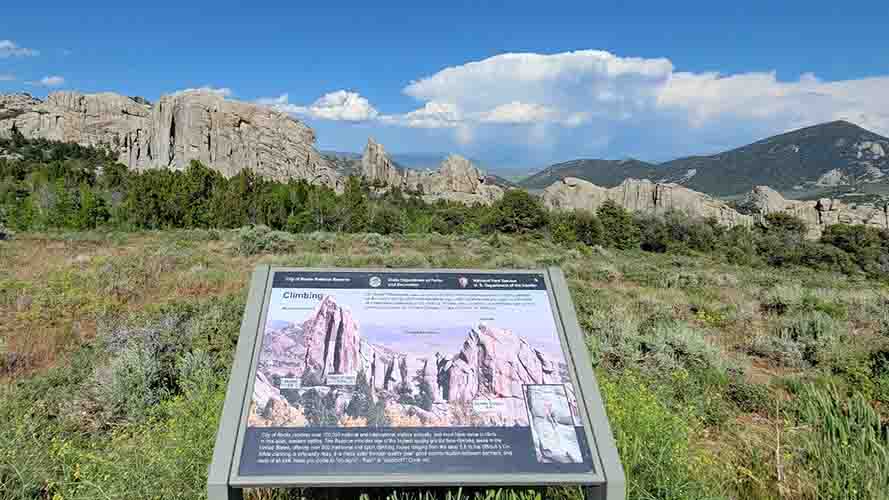
The area’s historical and geological values, scenery, and opportunities for recreation led to its designation as City of Rocks National Reserve in 1988 in recognition of the nationally significant geological and scenic values of its rock formations and the historical significance of the California Trail. City of Rocks has become a popular rock climbing area, boasting over 1,000 traditional and bolt-protected routes. In the 1980s, Idaho climber, Tony Yaniro, developed many of its routes, which are some of the most difficult routes in the country. Climbers simply refer to the area as “The City.”
Its unique Rock formations developed through an erosion process called exfoliation, during which thin rock plates and scales sloughed off along the rocks’ joints. The joints, or fractures, resulted when granite contracted as it cooled, upwardly expanding from regional tectonic stresses, as overlying materials eroded away. The granite abutments eroded into a fascinating assortment of configurations, up to 600 feet tall. Many of the rocks’ upper surfaces are covered with flat-floored weathering pits known as panholes. The most notable panhole is continually filled with water from rain or snowmelt, and is located on top of Bath Rock.
Source: Wikipedia, search “City of Rocks”: 2023
Leave a Reply
You must be logged in to post a comment.