
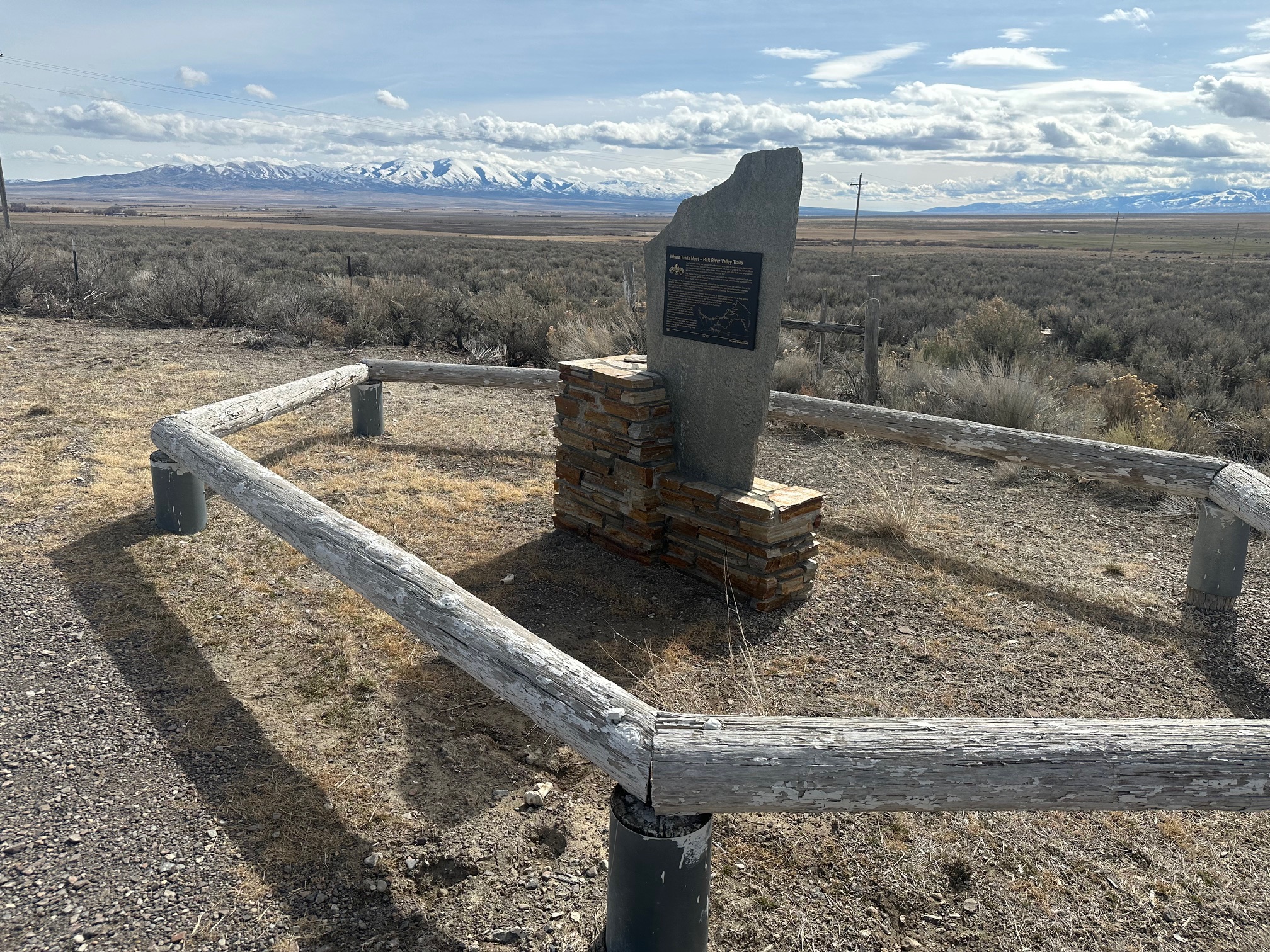
The scope of the western migration to the American West in the mid 1800s is mind-blowing. And most amazing of all is the fact that Cassia county is home to five main pioneer trails- the most of any county in the United States. The Oregon Trail, California Trail, Hudspeth Cutoff, Salt Lake Alternate, and Kelton Road are all virtually in our own backyard. It’s astounding just how much early history happened along the Snake River and Raft River Valley
The first known white person to die in Idaho, Antoine Clappine, of the 1811 John Jacob Astor party drowned in the Snake River, west of Burley in Caldron Linn, near Milner. Mountain men and explorers including William Ashley, Milton Sublette, Thamas, Broken-Hand Fitzgerald and John C. Fremont traveled through the Mini-Cassia area. The Mormon Battalion, returning home, after several discovered gold at Sutter’s Mill, California, forged a new passage through Nevada, continuing through southern Cassia county along the Raft River. This new passage became known as the Salt Lake Alternate, a major emigrant trail. Cattle barons herded enormous herds of cattle of up to 10,000 head along the fertile valleys, deep in three-to-six foot high grass in Raft River. Chief Pocatello, famous leader of the Northwest Shoshoni band, decided his nation must fight to protect his way of life, while living in the Raft River Valley. The famous Kelton Road, carrying ore from Boise and Wood River, traveled through The Raft River Valley. And those are just the highlights.
Oregon Trail: The combined California/Oregon Trail was the main thoroughfare to the west running from Independence, Missouri, across the plains of the Midwest, and through the towering Rocky Mountains, Traveling with as many as five wagons abreast to avoid congestion, they also hoped to cut down on the ever-present dust from the well-worn trail. Wikipedia states that the “Oregon Trail was a 2,170-mile east–west, large-wheeled wagon route and emigrant trail in the United States that connected the Missouri River to valleys in Oregon Territory.” The eastern Oregon Trail passed through what is now the states of Kansas, Nebraska and Wyoming on their way to the California Trail, Mormon Trail, and Bozeman Trail before turning off to their separate destinations.
The Oregon Trail and its many offshoots were traveled by about 400,000 travelers on their way to Oregon Territory, particularly from the early to mid-1830s, through 1846 to 1869. It has been estimated that over 50,000 wagons traveled south through Cassia county on the California Trail alone, leaving wagon ruts and assorted trail remnants that can still be seen, over 150 years later. After the first transcontinental railroad was completed in 1869, most traveling west rode the rails, since train fare was substantially faster, cheaper, and safer.The western half spanned through Wyoming and Idaho, then on to Oregon.
Parting of the Ways/California Trail: After leaving Wyoming’s Fort Bridger, it crossed into the Great Basin drainage of the Great Salt Lake, past present-day Soda Springs, Idaho and on to Fort Hall. From Fort Hall, the trails continued along the Snake River Valley to the “parting of the ways” trail junction at the convergence of the Raft and Snake Rivers in eastern Cassia county. There travelers had to choose whether to continue on to Oregon, traveling near the banks of the Snake River, through what is now Burley and Boise, then on to the Oregon Territory; or head south, traveling past the City of Rocks, over Granite Summit, following Raft River and the South Fork of Junction Creek. Determining which direction to go was not always a clear decision. In fact, one pioneer family let their ox team make the decision. Their party simply followed the team whichever direction they headed.
Our Unique Western Heritage: Preserving and monumenting the West’s historic trails is a serious concern for many individuals and groups. Portions of the trail are now preserved by the Bureau of Land Management (BLM), and the National Park Service (NPS) as the California National Historic Trail. Traveling along the trail corridor, white posts, made by the Carsonite company mark known trail segments. Commonly called Carsonite markers, the white posts are easily identifiable by those with a keen eye. Many Eagle Scout projects and similar community-based projects have helped identify and mark local sections of the trail.
Hundreds of thousands of Americans traveled westward during the migration of the 1840s and 1850s. Pioneers had a choice of trails, but none was easy. The Oregon Trail alone claimed some 34,000 lives—most from accidents or cholera. About one grave was dug for every hundred yards.The biggest fear was not finishing the journey before winter with its deadly storms. Those who were successful could claim inexpensive, fertile land and had an excellent chance of carving out a good life for themselves.
A nationwide group called the Oregon-California Trails Association (OCTA,) is especially involved in identifying, preserving and marking the trail. This group, organized in state and local chapters, provides educational historical materials about the trails for the benefit of the general public. The Idaho chapter of OCTA is quite active, taking field trips, examining known and suspected trail segments (they sometimes refer to themselves as “nut-ruts”) along the Oregon and California Trails. A recent field trip included members throughout the state, examining the trails south and west of Oakley. Since one of their members had spotted two suspected pioneer graves, a cadaver-sniffing dog was taken along, and both sites were verified as gravesites. The terrain was left undisturbed, though the sites may eventually be examined by archeologists.
The Oregon-California Trails Association, located at 524 Osage S. St. Independence, MO 64050 is a 501(c)(3) organization. Their phone number is 816 252-2276. Their website, octa-trails.org includes useful information including: People & Stores, Emigrant Trails Hall of Fame, Trail Facts, School Resources and OCTA Awards. Services provided include a Speaker’s Bureau, Member Publications and Regional Chapters. National and Regional conventions are held, with many chapters hosting field trips to explore trail remnants in their area.
The OCTA website, octa-trails.org states, “An American legacy is at risk. The historic trails trod by half a million pioneers, gold rushers, adventurers, families—people in pursuit of a better life in the West—are under constant threat from development, including energy-related projects. Many miles of wagon ruts and swales still exist in silent testimony to those hardy souls who built the nation as we know it today.”
OCTA offers a variety of materials, including Overland Journal, a quarterly magazine containing articles and book reviews concerning historic trails. News From The Plains, OCTA’s quarterly newsletter contains information about the activities of OCTA National, OCTA Regional Chapters, and OCTA members. OCTA members receive free access to Paper Trail, the website based on a searchable index of 19th Century westward American migration documents. New members are required to join OCTA National first and then can proceed to join their local OCTA Regional Chapters. Paper Trail is a searchable database of remarkable journeys, with names, places and a survey of the text; and includes a list of libraries where the original historic documents may be found.
Want to Learn More? Many excellent resources are available to those who want to learn more about our heritage and pioneer trails. “Emigrant Trails of Southern Idaho” published by Bureau of Land Management and Idaho State Historical Society in 1993 has detailed maps and diary entries covering all trails and branches of trails. “A Guide to the California Trail to the Humboldt River” published by Trails West, Inc. of Reno, Nev. has detailed maps and diary entries covering the California Trail from “The Parting of the Ways” near the confluence of Raft River and Snake River some 30 miles east of Burley to Wells, Nevada.
Sources: Wikipedia search: California Trail, Oregon Trail 6/15/24; octa-trails.org search 6/30/24,
Leave a Reply
You must be logged in to post a comment.